
Conor Warren, founder of youth-led mental health charity, Spark UK, believes that teens need to think twice before using AI as pastoral support.
According to the Youth Endowment Fund, one in four young people in the UK aged 13-17 have used AI chatbots to support mental health in the past year. This jump in numbers could be due to the “convenience of 24/7 access” that bots such as ChatGPT offer, Conor said.
Conor also spoke about how the anonymity of chatbots makes young people trust it over real people:
“A lot of young people might feel scared to speak to professionals about their feelings, because they feel that by speaking to a person, it might be escalated. They don’t want the police or parents being involved.”
Furthermore, ChatGPT mimics the voice of friendly conversation when you ask it for help. Conor said that this attracts more young people to turning to it for support.
“They can often feel that AI can become their best mate, and actually rather than ranting to their best friend at 3am, they can rant to AI instead.”
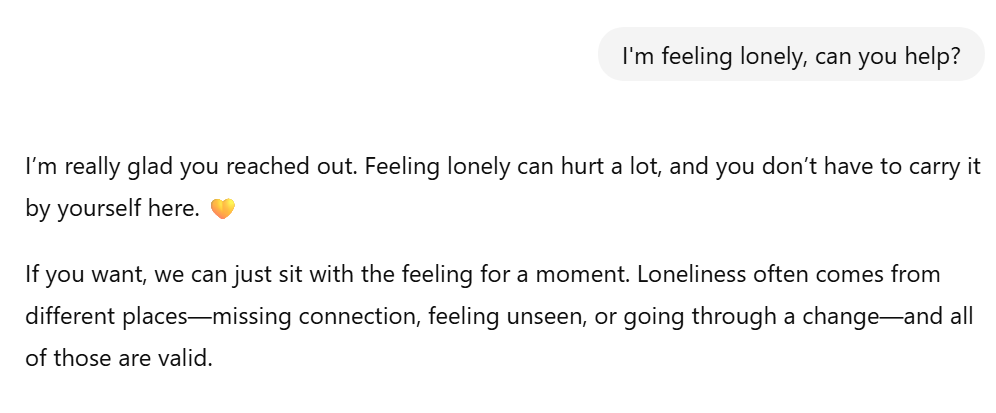
ChatGPT responds to a question concerning someone’s wellbeing
“Human interaction” unbeatable
However, AI chatbots pose significant risks when used in this way. Conor fears that the information it gives out may not be factual, as AI models “do not prioritize reliable sources” when searching for information.
Conor also believes that it’s important to remember that popular chatbots like ChatGPT “are mass-market commercial machines that are created to support the business side of things, rather than pastoral support.”
Instead of using AI, Conor said that we “cannot beat human interaction” when it comes to mental health support. He believes that, since the pandemic, we have become a “digital native world” through video calling platforms like Zoom, and have forgotten the benefits of talking face-to-face:
“You don’t get that human touch [with Zoom], that human interaction that you do in a face-to-face conversation, especially within therapy, it is really important for the therapist to be able to read body language.”
Face-to-face conversation is also promoted by Spark UK as a tool to help those who are struggling. On their website, they state that their mission is:
“To spark conversations around mental health and ensure that every young person feels heard, supported and empowered.”
Spark UK seek to provide “early intervention” to ensure less young people are struggling with their mental health. They aim to teach children and teenagers how to look after their wellbeing – including how to stay safe whilst using AI.
Conor believes that the safest way to use AI for these purposes would be to consider it “an absolute last resort”.
“But if someone was in that position, they need to take what it says with a pinch of salt. It must be understood that it’s not there for mental health support, it’s there as a model.”